Table of Contents
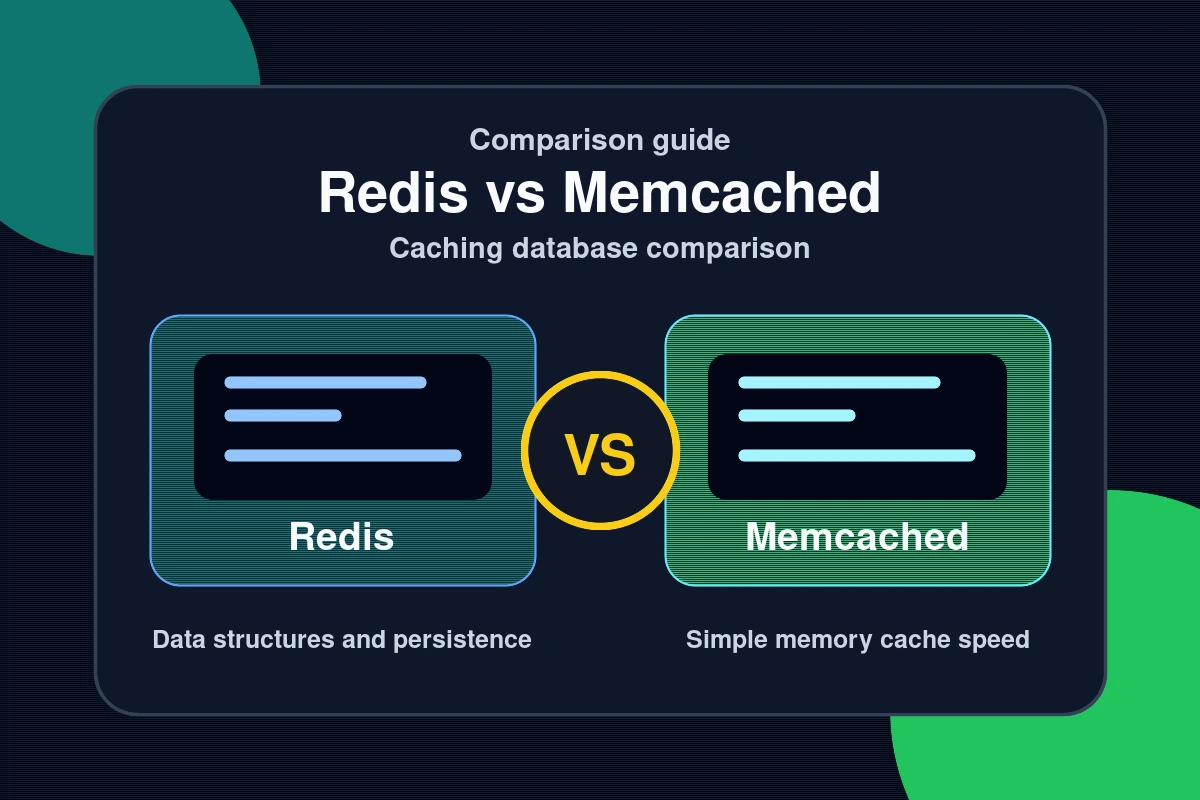
If you are building an application that needs fast in-memory caching, you will quickly encounter two names: Redis and Memcached. Both are battle-tested, open-source, and used by some of the largest websites in the world. Both store data in memory for microsecond retrieval. And both will solve the basic caching problem. But the two tools have diverged significantly over the past decade, with Redis growing into a multi-purpose data structure server while Memcached has remained a focused, high-performance pure caching tool. The Redis vs Memcached decision is less about which is better overall and more about which is right for your specific use case. This guide gives you the clear framework to decide.

What Are Redis and Memcached? The Core Difference
Memcached is a distributed memory caching system created by Brad Fitzpatrick in 2003 for LiveJournal and later made open source. Its design philosophy is radical simplicity: store key-value pairs in memory, retrieve them fast, evict them when memory fills up. That is essentially all it does—and it does it exceptionally well. Memcached has a minimal footprint, a simple architecture, and is trivially easy to scale horizontally by adding more cache nodes.
Redis (Remote Dictionary Server) was created by Salvatore Sanfilippo in 2009 and has evolved far beyond simple caching. Redis supports a rich set of data structures—strings, lists, sets, sorted sets, hashes, streams, bitmaps, and geospatial indexes. It offers optional persistence, pub/sub messaging, Lua scripting, Lua-based atomic transactions, cluster mode for horizontal scaling, and Sentinel for high availability. Redis is still used heavily for caching, but it is also used as a primary database, a message broker, a session store, a job queue, a leaderboard engine, and more. The question is not whether Redis is more powerful—it clearly is—but whether that power is what you actually need.
How Both Tools Handle Memory and Data
Both tools store data in RAM by design, which is why both offer microsecond read and write latency. Memcached stores all data as simple string values associated with string keys, with an upper limit of 1MB per item. It uses a slab allocator for memory management that is highly efficient for uniform-sized cache objects. Redis stores values as one of many supported data types, with no hard per-item size limit in most configurations. Redis also offers optional on-disk persistence through RDB snapshots and AOF (Append Only File) logging—meaning data can survive a restart, unlike Memcached which is purely volatile by design.
Redis vs Memcached: When to Choose Each One

The decision framework breaks down clearly across these key dimensions:
- Simple key-value caching at massive scale — Memcached wins: For pure caching of serialized objects (HTML fragments, database query results, API responses), Memcached’s multi-threaded architecture and minimal overhead give it a slight performance edge. Facebook uses Memcached at enormous scale specifically for this use case.
- Complex data structures — Redis wins: If you need to cache a sorted leaderboard, a list of recent activity, a set of unique visitors, or any data that is more than a flat blob, Redis’s native data structures make the code dramatically simpler and the operations more efficient.
- Data persistence — Redis wins: If your cached data needs to survive server restarts or you want to avoid cold cache problems after deploys, Redis’s persistence options are essential. Memcached loses all data on restart.
- Pub/sub messaging — Redis wins: Redis’s built-in pub/sub capability allows it to act as a lightweight message broker for real-time features like live notifications, chat, and event streaming. Memcached has no equivalent functionality.
- Session storage — Redis wins: Session data benefits from persistence, expiry management, and hash storage. Redis handles all three natively. Memcached can store sessions but lacks persistence and has limited expiry precision.
- Multi-threaded performance — Memcached has an edge: Memcached is natively multi-threaded and can utilize all CPU cores on a multi-core machine out of the box. Redis is single-threaded for core data operations (though Redis 6.0 added threading for I/O), which can be a bottleneck in extreme throughput scenarios.
For more technical deep-dives on infrastructure decisions like this, visit the Deep Dive section on HubKub.
Step-by-Step: How to Decide Between Redis and Memcached
Work through this decision process to make a confident, well-reasoned choice for your project:
- Define your caching use case precisely. Are you caching rendered HTML pages? Database query results? Session tokens? Real-time counters? User-specific data? The more specific you can be, the clearer the tool choice becomes.
- Determine whether you need data structures. If your cache values are always simple serialized blobs—JSON objects, HTML strings, binary data—Memcached is sufficient. If you need lists, sets, sorted sets, or hash maps as first-class cache values, Redis is the right choice.
- Evaluate persistence requirements. Ask: “What happens if this cache server restarts and all data is lost?” If the answer is “our application handles that gracefully by rebuilding from the primary database,” Memcached is fine. If the answer is “we have a cold cache problem or data loss issue,” Redis with AOF or RDB persistence is necessary.
- Check whether you need additional functionality. Does your application also need a job queue? Real-time pub/sub? Rate limiting? A leaderboard? If yes, Redis can handle all of these, potentially replacing multiple other infrastructure components and simplifying your stack.
- Benchmark with your actual workload. If performance at scale is your primary concern, benchmark both with a representative sample of your actual traffic patterns. The Redis official benchmarking guide provides a solid methodology for fair comparison.
- Consider operational complexity. Redis offers more features but also more configuration options, more monitoring surface area, and more failure modes to handle. If your team is small or your infrastructure is simple, Memcached’s simplicity has genuine operational value.
- Make the default choice Redis unless Memcached wins on a specific dimension. For most modern applications, Redis’s feature set makes it the more flexible long-term investment, and the performance difference for typical workloads is negligible in practice.
Common Questions — Redis vs Memcached
Is Redis faster than Memcached?
In most real-world benchmarks, the performance difference is negligible for typical application workloads—both operate in the sub-millisecond range. Memcached has a slight throughput advantage in highly concurrent, single-threaded-bottleneck scenarios due to its multi-threaded architecture. For most web applications, you will not be able to measure a meaningful performance difference in production between the two.
Can Redis completely replace Memcached?
For virtually all use cases, yes. Redis can do everything Memcached can do—and much more. The main reason teams choose Memcached over Redis in 2026 is existing infrastructure investment, specific multi-threaded performance requirements at extreme scale, or operational simplicity preferences. For new projects, Redis is the default recommendation unless there is a specific technical reason to choose otherwise.
How does Redis handle high availability?
Redis offers two primary high availability mechanisms. Redis Sentinel monitors Redis instances and automatically performs failover when a primary node goes down. Redis Cluster distributes data across multiple nodes for both horizontal scaling and fault tolerance. Managed Redis services—AWS ElastiCache for Redis, Google Cloud Memorystore, Upstash—handle most of this complexity automatically and are worth considering for teams that want Redis features without the operational overhead of running it themselves.
What is Redis used for beyond caching?
Redis is widely used as a session store, a job queue (via Redis Lists or dedicated libraries like Sidekiq and BullMQ), a real-time pub/sub message broker, a rate limiter, a leaderboard engine using Sorted Sets, a geospatial data store, a time series database via Redis TimeSeries, and as a vector database via Redis Vector Search for AI and RAG applications. Its versatility is one of the primary reasons it has grown into one of the most deployed data infrastructure tools in the world.
Conclusion: Redis for Most, Memcached for Pure Scale Simplicity
The Redis vs Memcached question has a clear answer for most teams in 2026. Three key takeaways to finalize your decision:
- Choose Redis if you need anything beyond simple string caching—persistence, data structures, pub/sub, clustering, or multi-purpose infrastructure. Redis is the right default for most modern applications.
- Choose Memcached if you need pure caching with maximum simplicity—specifically for applications doing enormous-scale key-value lookups where Memcached’s multi-threaded architecture and minimal overhead are worth the tradeoff in features.
- For new projects with no existing constraints, start with Redis. The feature depth becomes valuable as your application grows, and the performance difference for typical workloads will never matter in practice.
For more infrastructure guides and technical comparisons, explore the How-To section on HubKub. Whatever you choose, getting caching right is one of the highest-use performance investments you can make in any web application.
See also: Tech Comparisons: Side-by-Side Analysis of the Best Tools in 2026 — browse all Comparisons articles on Hubkub.
Related Articles
- VPS vs Cloud Hosting vs Shared Hosting: Which One Is Right for You?
- Nginx vs Apache for WordPress: Which Is Better in 2026?
- Blocksy vs Astra: Which WordPress Theme Is Better for Content Sites?
Last Updated: April 13, 2026
How to choose between these options
Use this decision checklist if you are comparing tools for real work rather than only reading feature lists.
- Primary task: choose the tool that solves your most frequent task with the least friction.
- Setup complexity: consider whether you need local installation, accounts, drivers, network access, or mobile permissions.
- Reliability: test the tool with your actual device, network, file type, or workflow before committing.
- Privacy and safety: review what data is transmitted, stored, mirrored, or synced.
- Fallback: keep an alternative ready if the tool depends on a network, cloud account, or platform-specific feature.
Related Hubkub resources: Content Quality Standards, Software Reviews, and Safe Software Downloads.
FAQ
How should I use this guide?
Use it as a practical starting point, then verify details against your own device, account, software version, or official documentation.
What if the information becomes outdated?
Technology changes quickly. If you notice outdated steps or broken links, use Hubkub’s contact or corrections policy pages so the article can be reviewed.