Table of Contents
- ChatGPT vs Claude vs Gemini: What Each Tool Actually Is
- Head-to-Head: Where Each AI Tool Wins in 2026
- Step-by-Step: How to Choose the Right AI Tool for Your Needs
- Common Questions — ChatGPT vs Claude vs Gemini: Which Is Best in 2026?
- Conclusion: Use All Three Strategically, Not Just One
- How to choose between these options
- FAQ
You have three browser tabs open: ChatGPT, Claude, and Gemini. You switch between them constantly, never quite sure which one to actually trust with your most important work. Sound familiar? As of early 2026, the AI assistant market has reached a tipping point where all three frontier models are genuinely excellent—yet meaningfully different in ways that matter enormously depending on what you need them for. The ChatGPT vs Claude vs Gemini question is not about which tool won—it is about which tool wins for you, on your specific tasks. This guide cuts through the hype and gives you a practical, current comparison.

ChatGPT vs Claude vs Gemini: What Each Tool Actually Is
Before comparing them, it helps to understand what each product is built for at its core. ChatGPT, built by OpenAI and powered by GPT-4o as its default model, is the most widely deployed AI assistant in the world. It has the broadest ecosystem, the most plugins, and the deepest integration into third-party tools via the OpenAI API. It was designed from the start for broad consumer and developer use.
Claude, built by Anthropic, was designed around AI safety principles and trained using Constitutional AI—a technique that makes it reason about ethics and helpfulness as core behaviors rather than external constraints. Claude Opus 4.6 and the Claude 3 family offer a 200,000-token context window, making them exceptional for long-document analysis. Claude tends to produce the most natural-feeling prose of the three and is notably honest about uncertainty.
Gemini, built by Google DeepMind, is designed as a multimodal-first model with native integration into Google’s ecosystem—Search, Workspace, YouTube, and Android. Gemini 1.5 Pro offers a 1 million-token context window, the largest of the three. Its deep integration with Google Search gives it real-time information access that neither ChatGPT nor Claude can match by default.
The 2026 Model Landscape at a Glance
Each provider now offers multiple model tiers. OpenAI’s lineup includes GPT-4o (the balanced flagship), o1 and o3 (reasoning-optimized models), and GPT-4o mini (cost-efficient). Anthropic offers Claude 3 Haiku (fast and cheap), Claude Opus 4.6 (best balance of speed and quality), and Claude 3 Opus (maximum capability). Google offers Gemini Flash (speed-optimized), Gemini Pro (balanced), and Gemini Ultra (maximum capability). All three companies now offer free tiers and paid plans around $20 per month for access to flagship models.
Head-to-Head: Where Each AI Tool Wins in 2026

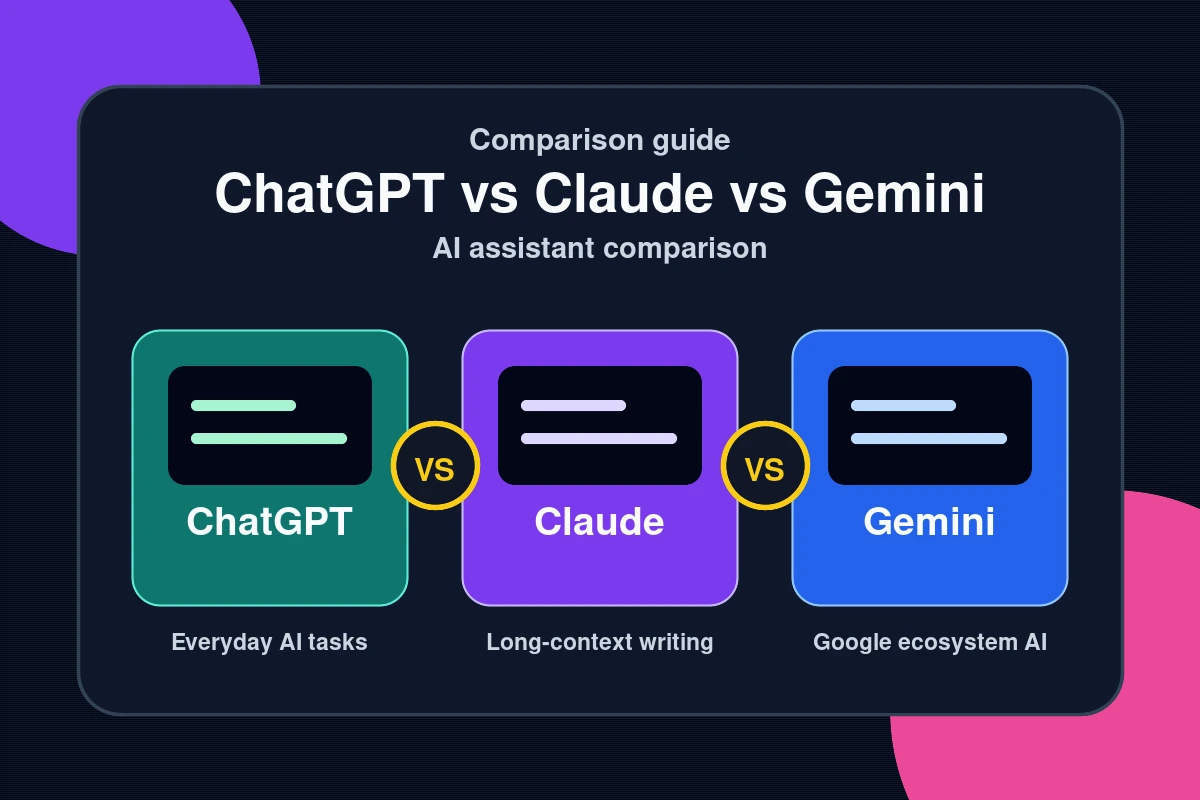
Rather than declaring an overall winner, here is how the three tools compare across the task categories that matter most to most users:
- Writing quality — Claude wins: Claude consistently produces the most natural, nuanced prose. It avoids the slightly formal, hedge-heavy writing style that marks ChatGPT output and handles sensitive or complex topics with more contextual sophistication.
- Real-time information — Gemini wins: Gemini’s native Google Search integration gives it access to current information by default. ChatGPT’s browsing is good but less seamlessly integrated. Claude currently lags behind both for real-time data access.
- Long document analysis — Claude wins: With a 200k-token context window and strong analytical reasoning, Claude handles long PDFs, reports, and codebases better than ChatGPT’s default. Gemini’s 1M token window is the largest available, though quality at very long ranges can vary.
- Coding assistance — ChatGPT and Claude roughly tied: Both perform at a very high level. Developers often prefer ChatGPT for speed and Copilot integration; Claude for careful reasoning about complex logic. Gemini’s coding capability has improved significantly but still trails on complex tasks.
- Google Workspace integration — Gemini wins decisively: If your workflow lives in Gmail, Google Docs, Sheets, and Meet, Gemini’s native integration is unmatched. The other two cannot compete in this specific context.
- Ecosystem and plugins — ChatGPT wins: The OpenAI plugin store and the ChatGPT API’s ubiquity in third-party tools give ChatGPT the broadest real-world tool connectivity by a significant margin.
- Transparency and honesty — Claude wins: Claude is more likely to acknowledge uncertainty, flag when it does not know something, and decline requests it finds problematic with clear explanations rather than silent refusal or compliant harm.
For detailed reviews of each individual AI tool, check out the Reviews section on HubKub.
Step-by-Step: How to Choose the Right AI Tool for Your Needs
Use this decision process to match the right tool to your specific workflow:
- List your top 5 AI use cases. Be specific: “Write blog posts,” “summarize research papers,” “generate code for my Python project,” “answer questions about my Google Calendar.” Vague use cases lead to poor tool choices.
- Check which use cases require real-time data. If you need current news, live prices, recent events, or any information that changes frequently, Gemini is the default best choice due to its native search integration.
- Check for long-document requirements. If you regularly work with documents longer than 100 pages, legal contracts, full codebases, or book-length content, Claude’s context window is a significant advantage.
- Audit your existing tool ecosystem. If you are deeply embedded in Google Workspace, Gemini should be your primary tool. If you rely on the OpenAI API or Microsoft Copilot, ChatGPT is the natural fit. If you prioritize writing quality and analytical depth, Claude deserves the primary slot.
- Run a structured comparison test. Take your three most common tasks and run them through all three tools using identical prompts. Score the outputs on accuracy, quality, and usefulness. Your own test with your own tasks is more reliable than any benchmark.
- Adopt a primary plus specialist model. Most power users land on one primary tool for 80% of tasks and keep the others available for their specific strengths. This is the most practical approach given that all three offer free tiers.
- Revisit your choice every six months. This space moves fast. A model that trails today may lead in six months. Staying current with the AI tool landscape—through sources like Artificial Analysis—ensures you are not missing meaningful improvements.
Common Questions — ChatGPT vs Claude vs Gemini: Which Is Best in 2026?
Which AI tool is best for beginners?
ChatGPT remains the most beginner-friendly option due to its polished interface, extensive documentation, and the sheer volume of tutorials and community resources available. Its free tier is generous, and the learning curve is minimal. Gemini is the best starting point for anyone already using Google products. Claude is excellent but slightly less intuitive for users who are new to AI assistants.
Which is the most accurate AI tool in 2026?
Accuracy varies significantly by task type. On factual recall benchmarks, all three frontier models perform similarly. On mathematical reasoning, OpenAI’s o1 and o3 models lead. On avoiding hallucinations in document analysis, Claude tends to perform best due to its tendency to acknowledge uncertainty. No single tool is most accurate across all task categories—task-specific accuracy is a more useful frame than overall accuracy rankings.
Is it worth paying for premium tiers of these AI tools?
For professional use, yes. Free tiers impose rate limits, use less capable model versions, and lack access to advanced features like extended context windows, priority processing, and enterprise integrations. At approximately $20 per month for any of the three premium plans, the productivity gains for regular professional use make the cost easy to justify. Many power users subscribe to two or all three plans given their distinct strengths.
Will one AI tool eventually dominate the others?
Consolidation is unlikely in the near term. OpenAI, Anthropic, and Google each have massive competitive moats—OpenAI in ecosystem and developer adoption, Anthropic in safety research credibility, and Google in data access, search integration, and enterprise distribution. All three are sufficiently funded to remain competitive for years. The more likely outcome is continued specialization, where each tool becomes distinctly best at a different category of tasks.
Conclusion: Use All Three Strategically, Not Just One
The ChatGPT vs Claude vs Gemini debate is a false choice. The real answer for serious users in 2026 is a deliberate combination of all three, each deployed for the tasks it handles best. Three key takeaways:
- Claude leads for writing quality, long-document analysis, and honest uncertainty handling—it should be the first choice for content creation and research tasks.
- Gemini leads for real-time information and Google Workspace integration—it is the right tool when current data and Google ecosystem connectivity matter.
- ChatGPT leads for ecosystem breadth, plugin access, and beginner accessibility—it remains the most versatile general-purpose tool and the safest default for new AI users.
Read more in-depth tool analysis in our Reviews section and stay current as these models continue to evolve. The best AI tool in 2026 is the one you have learned to use deliberately and well.
See also: Tech Comparisons: Side-by-Side Analysis of the Best Tools in 2026 — browse all Comparisons articles on Hubkub.
Related Articles
- Redis vs Memcached: What’s the Difference and Which Should You Use?
- VPS vs Cloud Hosting vs Shared Hosting: Which One Is Right for You?
- Nginx vs Apache for WordPress: Which Is Better in 2026?
Last Updated: April 13, 2026
How to choose between these options
Use this decision checklist if you are comparing tools for real work rather than only reading feature lists.
- Primary task: choose the tool that solves your most frequent task with the least friction.
- Setup complexity: consider whether you need local installation, accounts, drivers, network access, or mobile permissions.
- Reliability: test the tool with your actual device, network, file type, or workflow before committing.
- Privacy and safety: review what data is transmitted, stored, mirrored, or synced.
- Fallback: keep an alternative ready if the tool depends on a network, cloud account, or platform-specific feature.
Related Hubkub resources: Content Quality Standards, Software Reviews, and Safe Software Downloads.
FAQ
How should I use this guide?
Use it as a practical starting point, then verify details against your own device, account, software version, or official documentation.
What if the information becomes outdated?
Technology changes quickly. If you notice outdated steps or broken links, use Hubkub’s contact or corrections policy pages so the article can be reviewed.