Table of Contents
- What Is Claude? The Anthropic AI Explained
- Claude vs ChatGPT: Where Each One Wins
- Step-by-Step: How to Evaluate Which AI Is Right for You
- Common Questions — What Is Claude and How Does It Compare to ChatGPT?
- Conclusion: Claude and ChatGPT Are Different Tools for Different Jobs
- AI tool evaluation checklist
- FAQ
The AI assistant market has never been more competitive—or more confusing. Two names dominate most conversations: Claude, built by Anthropic, and ChatGPT, built by OpenAI. Both are large language model-powered assistants capable of writing, coding, analysis, and conversation, yet they were built with meaningfully different philosophies, strengths, and limitations. As of 2026, Claude has surpassed 10 million active users, making the Claude vs ChatGPT comparison one of the most-searched AI questions online. This guide breaks down what Claude is, how it was built, and where it genuinely outperforms—or falls short of—ChatGPT, so you can make an informed choice for your workflow.

What Is Claude? The Anthropic AI Explained
Claude is a large language model developed by Anthropic, an AI safety company founded in 2021 by former OpenAI researchers, including Dario and Daniela Amodei. Unlike OpenAI, which has pursued rapid capability scaling with broad commercial deployment, Anthropic was founded explicitly around the principle of building AI that is safe, interpretable, and beneficial. Claude is the direct product of that philosophy.
Claude is trained using a technique Anthropic calls Constitutional AI (CAI), which involves giving the model a set of principles—a “constitution”—and training it to evaluate and refine its own responses against those principles. The result is an assistant that is notably thoughtful about nuance, tends to acknowledge uncertainty honestly, and is less prone to confident hallucination than many competing models. Claude 3.5 Sonnet and Claude 3 Opus, the most recent flagship versions as of early 2026, offer a 200,000-token context window—one of the largest available—making them exceptionally capable for tasks involving long documents.
Claude’s Core Design Principles vs OpenAI’s Approach
Anthropic’s Constitutional AI approach trains Claude to reason about ethics and helpfulness as part of its core behavior, not as an external filter applied after generation. This tends to produce responses that are more contextually nuanced and less likely to be blindly compliant with problematic requests. OpenAI’s approach with ChatGPT relies more heavily on Reinforcement Learning from Human Feedback (RLHF) and a separate moderation layer. Neither approach is strictly superior, but they produce noticeably different personalities in the two assistants—Claude tends to feel more reflective and cautious, while ChatGPT tends to feel more responsive and direct.
Claude vs ChatGPT: Where Each One Wins

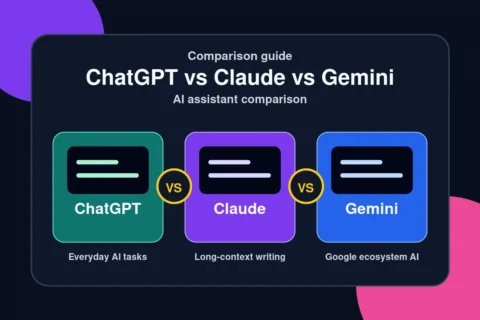
Rather than declaring one definitively better, it is more useful to map each tool’s strengths against specific use cases:
- Long document analysis — Claude wins: Claude’s 200k token context window dramatically outpaces ChatGPT’s standard limits. Feeding a 300-page PDF, a full codebase, or a lengthy legal document is a task Claude handles that ChatGPT struggles with.
- Integrations and plugins — ChatGPT wins: ChatGPT’s plugin ecosystem and deep integration with Microsoft’s Copilot suite give it a broader real-world tool connectivity advantage for business users.
- Creative writing with nuance — Claude wins: Claude consistently receives higher marks for prose that feels natural, avoids cliches, and handles sensitive topics with appropriate care.
- Code generation — Roughly equal: Both perform at a high level. ChatGPT with GPT-4o is slightly more popular among developers for its speed; Claude is preferred for tasks requiring careful reasoning about complex logic.
- Honesty about limitations — Claude wins: Claude is notably more willing to say “I don’t know” or flag uncertainty rather than confidently generate plausible-sounding errors.
- Image generation — ChatGPT wins: ChatGPT integrates with DALL-E for image creation; Claude does not offer image generation as of early 2026.
For a deeper look at how these tools fit into modern AI workflows, visit the AI section on HubKub.
Step-by-Step: How to Evaluate Which AI Is Right for You
Follow this decision framework to choose between Claude and ChatGPT for your specific needs:
- Define your primary use case. Writing, coding, research, customer support, document analysis? Each use case has a different leader. Start by listing your top three tasks.
- Check context window requirements. If you regularly work with documents longer than 50 pages or codebases with many files, Claude’s extended context window is a significant advantage. Test it at claude.ai.
- Test both on the same prompt. Give both assistants your single most important recurring task and compare the outputs side-by-side. Quality differences often become obvious immediately for domain-specific work.
- Evaluate integration requirements. If your workflow depends on third-party tool connections—calendar, email, browser search, image generation—audit which model’s ecosystem supports more of them natively.
- Consider the pricing structure. Both offer free tiers. Claude Pro and ChatGPT Plus are similarly priced at around $20 per month. For API usage at scale, compare the per-token pricing of each model tier against your volume.
- Run a one-week trial with each. Commit to using one tool exclusively for a full week before switching to the other. This gives you enough data points to form a genuine preference rather than relying on hype or surface-level impressions.
Common Questions — What Is Claude and How Does It Compare to ChatGPT?
Is Claude safer than ChatGPT?
Anthropic was founded specifically around AI safety research, and Claude’s Constitutional AI training reflects that priority. In independent benchmarks measuring refusals of harmful requests and acknowledgment of uncertainty, Claude typically performs more cautiously than ChatGPT. However, “safer” depends on context—for many creative and professional tasks, both models perform well within acceptable limits.
Can Claude access the internet?
Claude does not natively browse the web in its standard interface, though Anthropic has released tools that enable web search for specific use cases. ChatGPT’s browsing capability is more mature and widely available. If real-time information access is critical to your workflow, ChatGPT currently has an edge.
Which is better for writing long-form content?
Claude is generally preferred for long-form writing because of its larger context window, more natural prose style, and tendency to maintain consistency across lengthy documents. For short-form content—social media posts, email drafts, brief summaries—both tools perform comparably and the difference is largely a matter of personal preference.
Are there tasks where neither Claude nor ChatGPT excels?
Yes. Neither model is reliably accurate for real-time data, complex multi-step mathematical reasoning without verification, or highly specialized domain knowledge at the frontier of a field. Both can produce confident-sounding errors in these areas. For tasks requiring current information or high-precision technical accuracy, always verify outputs against authoritative sources.
Conclusion: Claude and ChatGPT Are Different Tools for Different Jobs
The Claude vs ChatGPT debate is not really a competition—it is a compatibility question. The right tool depends entirely on what you need to accomplish. Three key takeaways to guide your decision:
- Claude excels at long-context tasks, nuanced writing, and honest uncertainty acknowledgment—making it ideal for document analysis, research, and thoughtful content creation.
- ChatGPT leads on integrations, plugin ecosystems, and image generation—making it the stronger choice for workflow automation and multimedia tasks.
- The best approach for serious users is to run both. Free tiers make this feasible, and using each tool where it is strongest will give you better results than betting everything on one.
Want to go further? Read our AI tool reviews for detailed breakdowns of the latest AI assistants and how they perform on real-world tasks. Choose the tool that fits your workflow—then master it.
See also: AI Tools and Guides: Everything You Need to Know in 2026 — browse all AI articles on Hubkub.
Related Articles
- What Is Ollama Cloud and Is It Good for AI Workflows?
- What Is an AI Agent and How Is It Different from a Chatbot?
- What Is Prompt Engineering and Does It Still Matter in 2026?
Last Updated: April 13, 2026
AI tool evaluation checklist
AI product claims can change quickly. Before relying on this tool or model in a real workflow, compare the current official documentation, pricing, data policy, and limits with your use case.
- Use case fit: define whether you need writing, coding, research, automation, image/video work, or enterprise controls.
- Data risk: avoid pasting confidential customer data, credentials, private source code, or regulated records unless your plan and policy allow it.
- Verification: fact-check important outputs against official sources or direct testing.
- Cost and limits: review message caps, context limits, file support, API pricing, and team controls before adopting it widely.
Related Hubkub resources: AI Tools Guides, Content Quality Standards, and AI Usage Policy.
FAQ
Can I rely on AI output without checking it?
No. Important AI outputs should be verified against official sources, direct testing, or expert review, especially for technical, financial, legal, or security decisions.
What data should I avoid entering into AI tools?
Avoid confidential customer data, passwords, private keys, regulated records, and private source code unless your organization explicitly permits it.