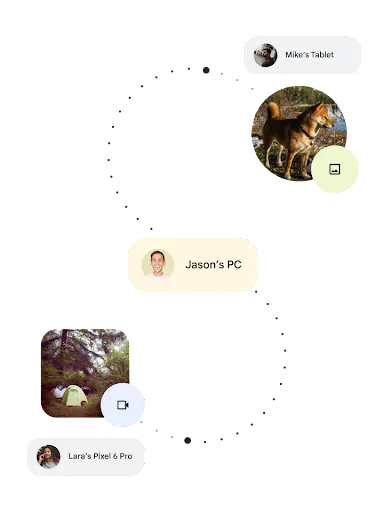
Quick Share for Windows is still a credible download in 2026 when the real use case matches what the official source promises. This review is based only on official sources checked on April 20, 2026. I used Thaiware only for product discovery provenance, then verified the official homepage, official download path, official docs or help surface, and official release or context source before treating this page as writing-ready.
Last updated: April 20, 2026
- Rechecked the official homepage, download path, and source-of-truth support links for this product.
- Confirmed the featured image source, downloads category fit, and safe-download path for this canonical review.
Key takeaways
- Quick Share for Windows is still the cleanest first-party path for moving files between Android devices and nearby Windows PCs when the hardware and OS match Google’s support rules.
- Official proof checked: live Android landing page, live Android Help article, and the official Google blog context behind the Quick Share naming shift.
- The biggest practical limit is compatibility: Windows 10 or later, 64-bit only, and no ARM support according to the official page.
Official download path for Quick Share for Windows Review
Hubkub does not host installers. Use the official vendor/project page first, then use this review to check fit, limits, and safer setup notes.
Hubkub verification notes for Quick Share for Windows Review
- Official download/support links already cited on this page were checked as the preferred source path for Quick Share for Windows Review.
- Hubkub does not host installer files; the download action points readers back to the official vendor or project source.
- This page separates practical fit, trade-offs, and safety notes so readers can decide whether Quick Share for Windows Review matches their workflow.
What I verified for this review
- Review type: official-source review
- Thaiware discovery URL: https://software.thaiware.com/download/Quick-Share-for-Windows
- Official homepage: https://www.android.com/better-together/quick-share-app/
- Official download URL: https://www.android.com/better-together/quick-share-app/
- Official docs/help checked: https://www.android.com/better-together/quick-share-app/
- Official release source checked: https://blog.google/products/android/ces-2024-android-updates/
- Latest stable version checked: Google does not expose a clean public Windows app version string on the landing page for this update
- Release date shown on the official page: January 2024 public rename / rollout context on the official Google blog
- Current official installer artifact seen: Official Android page states Windows 10 or later, 64-bit only, with no ARM support
- Concrete proof marker: Official page documents Windows 10+ 64-bit support, no ARM support, and the supported Android-to-PC sharing workflow
- Official OS support checked: Windows 10 or later, 64-bit only, no ARM support; Android device required for the core workflow
Official resources
Why Quick Share for Windows still matters in 2026
Quick Share for Windows still matters because nearby device transfer remains one of the most annoying small workflows on mixed Android and Windows setups. Readers keep searching for it because they want something simpler than emailing themselves, using a cloud sync folder, or plugging in a cable just to move a screenshot or a document.
For this review I used Thaiware only for product discovery provenance, then verified the live Android by Google landing page, the official Android Help article, and the official Google blog context around the Quick Share naming rollout. That is the right truth layer for a Google utility where the support rules matter more than flashy version marketing.
The public proof markers are compatibility-focused rather than version-focused. Google clearly documents that the Windows app is for Windows 10 or later in 64-bit form and does not support ARM devices. For a transfer utility, that support baseline is more useful than pretending a missing public version string is not a limitation.
Best for and core workflow
Quick Share for Windows is best for people who want a first-party Android-to-Windows nearby transfer workflow with minimal setup. It fits personal use well: moving screenshots, photos, PDFs, and folders between a phone and a nearby Windows PC without building a larger sync stack.
It is a weaker fit if you need cross-platform symmetry across Linux, macOS, and Windows or if your PC is ARM-based. In those cases, a tool like LocalSend or KDE Connect may fit better.
Pricing or license reality
Google presents Quick Share for Windows as a free utility. The real constraint is not price but platform scope: it depends on Android plus a compatible Windows PC, and the official page explicitly rules out ARM devices for this current public app route.
That means the buying logic is simple. You are not deciding between free and paid tiers; you are deciding whether your devices match the supported workflow.
What I learned from the official proof layer
The strongest proof layer is the official landing page and help article. Google currently exposes the nearby-sharing purpose clearly, outlines the install-and-setup flow, and states the important Windows compatibility limits in plain language. That is more useful than a directory page repeating vague feature claims.
The one thing Google does not expose cleanly on the public landing page is a neat Windows app version string. Instead of inventing one, this review keeps the proof layer honest and focuses on the support baseline, official workflow description, and first-party source path.
Comparison table
| Tool | Best for | Why you might choose it | Main caveat |
|---|---|---|---|
| Quick Share for Windows | Best for first-party Android-to-Windows nearby transfer | Official Google path with simple sharing flow | Windows-only PC side and no ARM support |
| LocalSend | Best for no-account local transfer across many platforms | Very flexible cross-platform sharing | Not a first-party Google workflow |
| KDE Connect | Best for richer device integration | Adds notifications and broader device features | Heavier setup than a simple transfer app |
| Intel Unison | Best for broader phone-PC integration on supported systems | More than file transfer alone | Different product scope and support constraints |
Safe official download notes for Quick Share for Windows Review
Use the official Android by Google Quick Share for Windows page and the official Android Help article. Avoid random reposted installers because compatibility rules and support links matter as much as the download itself.
For this update I verified the official landing page, official help page, and the Google blog context. I did not run a live transfer test on a supported Windows PC for this update, so this remains an official-source review rather than a hands-on install review.
Quick Share for Windows Review pros and cons: fit notes
Pros
- Strong first-party trust path from Google
- Simple nearby transfer workflow for Android and Windows
- Official compatibility rules are clearly documented
- Good fit for quick personal file moves
Cons
- No ARM support on the current public Windows route
- Windows side is less flexible than cross-platform alternatives
- Public version string is not cleanly exposed on the landing page
Alternatives worth checking
If you want broader platform coverage, LocalSend is the stronger multi-device choice. If you want deeper phone-to-PC integration, KDE Connect can do more than just transfers. If you want a more feature-rich PC companion idea, compare this with Intel Unison or similar tools.
Who should download Quick Share for Windows Review?
Quick Share for Windows is a safe official download in 2026 when your real need is simple nearby transfer between Android and a compatible Windows PC. The first-party trust path is strong, and the support rules are clearly documented.
It is not the most flexible cross-platform tool, but for the narrow Android-plus-Windows use case it remains a clean default recommendation.
Quick Share for Windows Review download and safety questions
Is Quick Share for Windows free?
Yes. Google presents Quick Share for Windows as a free utility. The real limit is compatibility, not price, so the main decision is whether your Android device and Windows PC match the official support rules.
Is Quick Share for Windows safe to download?
Yes, when you use the official Android by Google page and the official Android Help article. For this review I verified those first-party sources instead of relying on reposted installers or generic software-directory summaries.
What Windows versions are supported?
The official page states that the app is for Windows 10 or later in 64-bit form and that ARM devices are not supported. That is the most important technical fact to confirm before you try the install flow.
Does Quick Share for Windows have a public version number?
Google does not expose a clean public Windows app version string on the landing page used for this update. Rather than inventing one, this review focuses on the official compatibility and workflow proof markers that are publicly visible.
Should I choose Quick Share or LocalSend?
Choose Quick Share when you want the first-party Google route for Android-to-Windows transfers. Choose LocalSend when you want broader cross-platform flexibility and less dependence on one vendor’s ecosystem.
Reader-first software checklist
Before installing or switching to this software, use this quick checklist to confirm whether it fits your needs and risk tolerance.
- Official source: prefer the developer website, official documentation, or a clearly trusted distribution channel.
- Platform fit: check whether your Windows, macOS, Linux, Android, or iOS version is supported.
- License and cost: confirm whether the app is free, open source, freemium, trial-based, or paid.
- Privacy and permissions: review what files, folders, network access, account data, or browser permissions the app may use.
- Backup first: for recovery, storage, networking, privacy, or system utilities, back up important data before changing settings.
Safe download and setup notes
Hubkub does not recommend clicking misleading download buttons or installing unknown bundles. When possible, use the official source and avoid third-party installers that add toolbars, browser changes, or unrelated offers. After downloading, verify the file name, publisher, version, and installer prompts before continuing.
Pros, limits, and alternatives to consider
- Best fit: readers who need the core function described in this guide and prefer a practical setup path.
- Watch out for: outdated versions, unsupported platforms, unclear installers, or features that require paid upgrades.
- Compare alternatives: if this app feels too complex, too limited, or not maintained enough for your workflow, compare it with similar tools before installing.
Related Hubkub resources: Safe Software Downloads, Software Reviews, How We Review Software, and Content Quality Standards.
FAQ
Should I download this software from any mirror site?
Use the official developer website or a trusted distribution channel whenever possible. Mirror sites can be useful in limited cases, but they may also include outdated installers, misleading ads, or unwanted bundles.
What should I check before installing?
Check the publisher, version, license, supported operating system, installer prompts, and whether the app requests sensitive permissions.